Energy needs water, and water needs energy
The mutual dependence of energy and water and increasing global demand for each has an enormous impact on economic growth, environmental sustainability and our future in general.
Yet digitalization and existing technologies designed to create an energy-neutral water sector are already available. A more energy efficient water distribution system automatically helps reduce water leakage. Less energy is used. Less water is wasted.
Solving the future energy challenges of the water sector, today

- According to World Economic Outlook, “water crisis” is ranked the fifth most serious risk the world faces over the next 10 years [1].
- It is estimated that in 2025, half of the world’s population could be living in water stress and scarcity areas [2].
- In about half of all EU member states, more than 24% of clean drinking water is lost due to leakages [3]

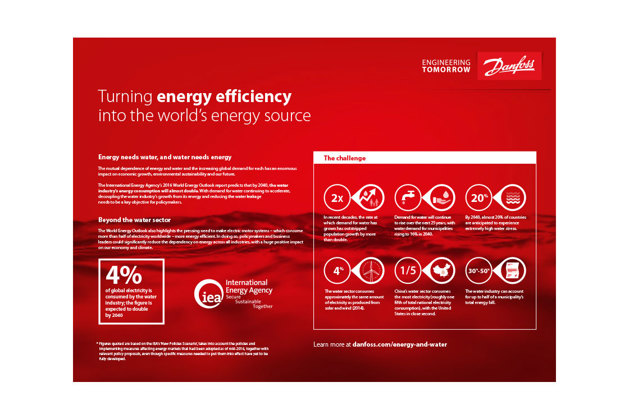
- 4% of global electricity is consumed by the water industry [4]. This figure is expected to double by 2040 [5].
- At the EU level, the water sector accounts for 3.5% of total electricity consumption [6].
- Water and wastewater facilities are a municipality’s largest consumer of electricity, representing 30-50% of local authorities’ total electricity bill [7].
Decoupling the water sector from energy use
The International Energy Agency report – World Energy Outlook [8] – explores the water-energy nexus, not only highlighting the challenges we’re facing but also the potential of achieving an energy-neutral water sector.
Existing technologies designed to reduce energy consumption in all stages of the water cycle – from production and distribution to wastewater pumping and treatment – already exist. Denmark is expected to achieve this goal within a few years. Not only can the water cycle be made more efficient, it has the potential to actually generate energy. And as part of optimizing the energy consumption in the water distribution system, water leakage will be automatically reduced.

Turning a city’s largest energy consumer into an energy producer
The Marselisborg catchment area in Aarhus (second municipality in Denmark) has achieved 100% energy surplus production by minimizing consumption throughout the whole water cycle and maximizing energy production from the wastewater facility. This has been achieved without adding external carbon to the wastewater facility or using any other external energy source [9].

A win-win solution
Apart from tackling the water scarcity problem by reducing water loss, an energy-neutral water sector also contributes to reducing CO2 emissions and brings significant savings in the OPEX and CAPEX of utility companies.
Read more about applications and solutions for Water and Wastewater
How can more water treatment cut CO2 emissions?
Expanding water treatment globally is not only a key enabler for creating a better world for humankind. Water treatment can also contribute to fighting climate change and reduced CO2/GHG emission.
Read article by Mads Warming, Global Director Water, Wastewater & Pumps and explore how we can decarbonize the wastewater industry.